Marine Life
Sea Turtles: Species, Behavior and Where to Dive With Them
A diver's guide to sea turtles — the species you meet underwater, how they behave, where to see them, how to photograph them, and their conservation status.
- Scientific name
- Chelonioidea (sea turtles)
Few encounters underwater are as universally loved as a sea turtle. Unhurried, ancient-looking, and often entirely unbothered by divers, they are among the most photographed animals on any reef. For all their familiarity, though, most divers could not name the species in front of them or explain what it is doing — so here is a diver’s guide to the turtles you meet, how they live, and where to find them.
The seven species
There are seven species of sea turtle worldwide: the green, hawksbill, loggerhead, leatherback, olive ridley, Kemp’s ridley, and flatback. They range across tropical and temperate oceans, but only two turn up regularly on the coral reefs where most recreational diving happens — the green and the hawksbill. The others are more oceanic, like the vast leatherback, or concentrated around specific nesting regions, so a reef diver’s turtle is almost always one of the first two.
Green versus hawksbill
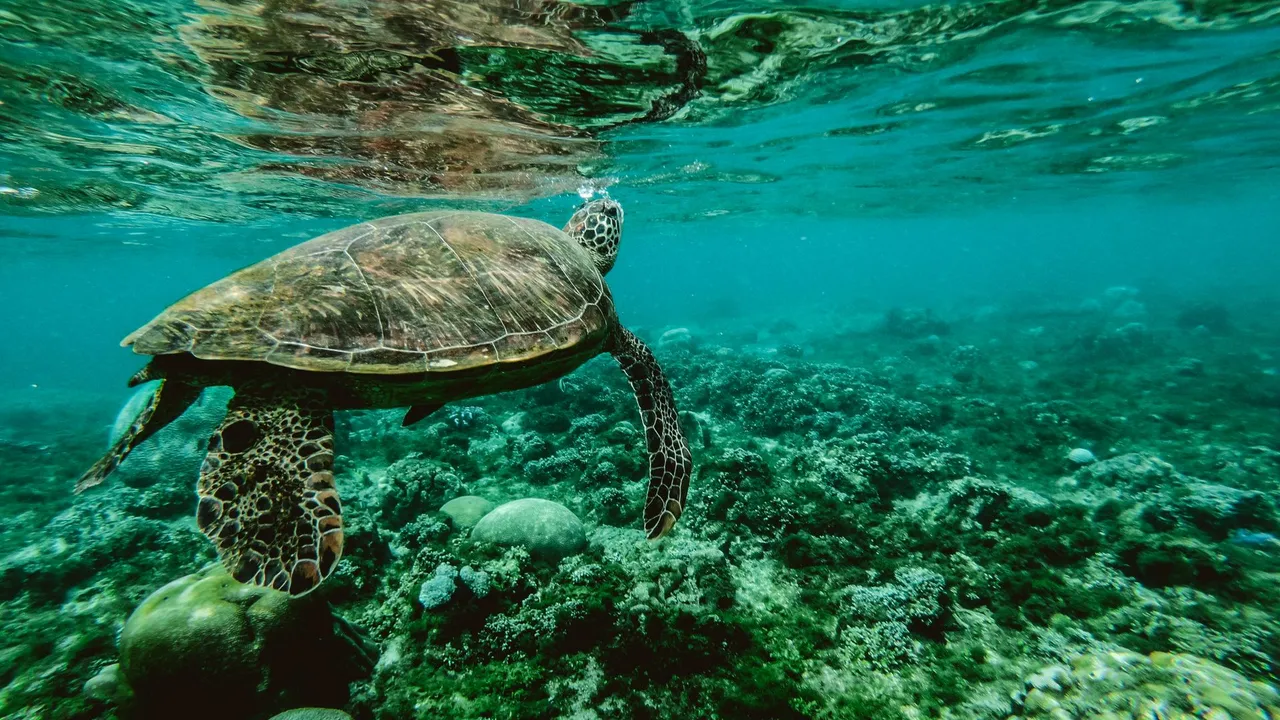
Telling them apart is easy once you know where to look. A hawksbill has a narrow, pointed beak — the hawk-like bill that gives it its name — and overlapping, serrated scales along the edge of its shell, and it feeds mainly on sponges tucked into the reef, which makes it an important part of reef health. A green turtle is bulkier, with a rounder, blunter head and a smoother shell, and it grazes on seagrass and algae. The name refers to the greenish fat beneath its shell, not its colour. Both are frequently seen resting under ledges or on the reef and visiting cleaning stations, where small fish pick parasites and algae from their shells and skin.
Behaviour underwater
The single most important thing to remember is that turtles are air-breathing reptiles. A resting turtle, its metabolism slowed, can stay submerged for hours, but an active one surfaces to breathe every few minutes. Underwater they spend their time grazing, resting, and being cleaned, and a relaxed turtle will often let a calm, slow diver approach closely. That trust is easily broken: a turtle that feels pursued will swim off, wasting energy, and one prevented from reaching the surface is in real trouble. Watching without interfering is the whole skill.
Where to dive with sea turtles
Turtles appear on healthy reefs throughout the tropics, but a few places are exceptional. Sipadan in Malaysian Borneo is legendary for them — green and hawksbill turtles are so numerous there that counting becomes pointless, and encounters are all but guaranteed. In Indonesia, Raja Ampat and Komodo both hold good numbers on their reefs. More broadly, anywhere with intact seagrass beds and coral tends to have resident turtles, which is why they feature on dive trips across Southeast Asia — see the dive destinations hub for more.
Photographing sea turtles
Turtles are a forgiving subject: large, slow, and often cooperative. The best approach is to move calmly, stay low, and let the animal set the pace rather than chasing it for a face-on shot. Shooting slightly upward, with the turtle against the surface light, gives clean separation and a classic look. As with any underwater image, water strips warm color with depth and distance, so a turtle shot usually needs a color pass afterward — it helps to understand why underwater photos look blue and how to restore underwater photos. If you shoot an action camera, our camera guides cover the gear, and you can see recoverable results in the before-and-after gallery.
Conservation
Sea turtles are a genuine conservation story, and a mixed one. In October 2025 the IUCN downlisted the green turtle globally from Endangered to Least Concern, reflecting decades of protection and a worldwide population rebound — a rare piece of good news. It comes with a caveat: the species is still conservation-dependent, and several regional subpopulations remain threatened, so the recovery depends on the protections continuing. The hawksbill, by contrast, remains Critically Endangered, hit hard by the historic tortoiseshell trade and ongoing pressures. Across all species the threats are familiar — bycatch in fishing gear, plastic, coastal development that erases nesting beaches, and warming that skews hatchling sex ratios. As a diver, the contribution is simple: keep your distance, never touch or feed, and support operators and reef sites that protect their turtles.
Plan a trip
To dive with turtles, start with Sipadan, then explore the wider Southeast Asia diving calendar for when and where to go. For more on the animals you will meet, browse the other marine life guides and the rest of OceanDimana.
Field notes
Frequently asked questions
How many species of sea turtle are there?
Which sea turtles do divers usually see?
How do you tell a green turtle from a hawksbill?
Where is the best diving with sea turtles?
Are sea turtles endangered?
Is it okay to touch or ride a sea turtle?
How long can a sea turtle stay underwater?
Keep exploring
Continue exploring
Diving Sipadan
The Malaysian island where green and hawksbill turtles are almost guaranteed on every dive.
Read moreManta Rays
The ocean's gentle giants — how to identify them and where to dive with them.
Read moreDiving Raja Ampat
The richest reefs on Earth, and reliable turtle territory in eastern Indonesia.
Read moreWhy Underwater Photos Look Blue
The science behind the blue-green cast, and why water steals warm color.
Read more