Marine Life
Nudibranchs: The Ocean's Most Colorful Sea Slugs
A diver's guide to nudibranchs — what these colorful sea slugs are, how they live, where to find them, and how to photograph them underwater.
- Scientific name
- Nudibranchia (nudibranchs)
If frogfish are the reef’s masters of disguise, nudibranchs are its show-offs. These small, shell-less sea slugs come in a riot of colours and improbable shapes, and hunting for them has become an obsession for macro divers and photographers. They are everywhere once you learn to look, and no two dives turn up quite the same cast. Here is what they are, how they live, and where to find them.
What a nudibranch is
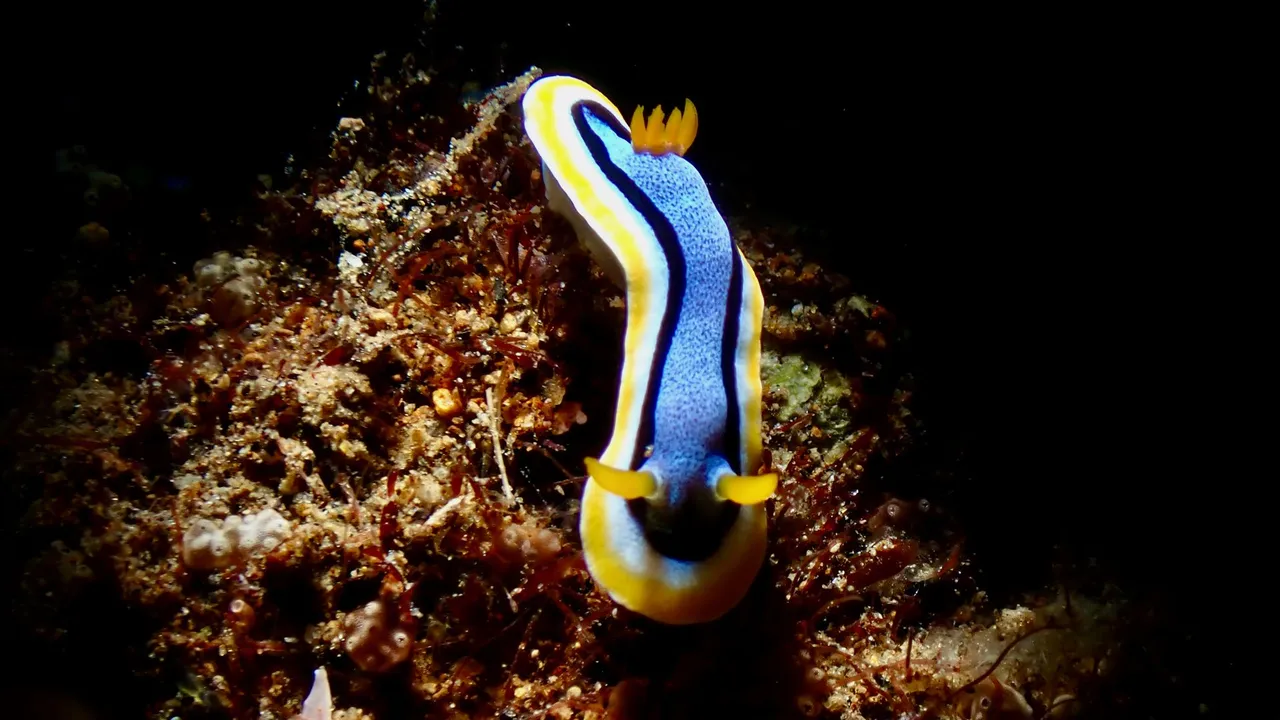
Nudibranchs are marine molluscs — sea slugs — in the order Nudibranchia, and there are thousands of described species with more found regularly. As larvae many have a shell, but they lose it as they mature, leaving a soft, exposed body that has evolved in wildly different directions. The name means “naked gills,” a reference to the feathery breathing structures many of them wear openly on their backs. They are related to snails, but you would never guess it from the neon flatworms and feathered jewels that crawl across a muck slope.
Colour, defence, and diet
A nudibranch’s colours are rarely just for show. Most are a warning: many species are toxic or unpalatable, and some perform a remarkable trick, eating stinging hydroids or anemones and storing the still-functional stinging cells in the finger-like cerata on their backs, turning their prey’s weapons into their own defence. Bright colouration advertises all this to would-be predators, while other species use colour and shape to disappear into the sponges and corals they sit on. Diet is highly specialised — each species tends to eat one particular sponge, hydroid, or bryozoan, and some eat other sea slugs — which is a gift for divers, because a nudibranch lives wherever its food grows.
Anatomy a diver can spot
Two features help you read a nudibranch underwater. The pair of “horns” on the head are rhinophores, chemical-sensing organs the animal uses to track down food and mates. The feathery tuft toward the rear, on many species, is the gills — the exposed breathing apparatus the group is named for. Beyond that the variety is endless: the two big groups a diver meets are the dorids, often oval with a gill rosette at the back, and the aeolids, slender and covered in the finger-like cerata that store those stinging cells. Nudibranchs are also hermaphrodites, carrying both sexes, which helps a slow-moving animal make the most of any encounter with another of its kind.
Where to find nudibranchs
Nudibranchs live on reefs and muck bottoms all over the world, but the macro capitals are unbeatable for variety. The Lembeh Strait in North Sulawesi, Indonesia, is a nudibranch mecca, turning up dozens of species on a single dive, and Anilao in the Philippines rivals it. Because they are small and everywhere, though, you do not need a famous site — a slow, patient dive with a sharp eye will find nudibranchs on almost any healthy reef. The Southeast Asia diving calendar covers the region’s best macro seasons.
Photographing nudibranchs
Nudibranchs are the quintessential macro subject: small, slow, and spectacularly detailed. The classic shot frames the animal side-on with the rhinophores sharp, and getting low to the subject’s level rather than shooting down on it transforms the result. Because they barely move, there is time to compose carefully — but the same care applies as with any critter: never move a nudibranch or its perch for a better angle. A close-up capable camera makes all the difference; our camera guides cover the gear, including the macro strengths of a dedicated compact like the OM System TG-7. And since water shifts color even at close range, shots benefit from a color pass afterward — see why underwater photos look blue, the best underwater photo editor options, and the before-and-after gallery.
Plan a trip
To fill a logbook with nudibranchs, base yourself in the Lembeh Strait and use the Southeast Asia diving calendar to plan. For more on the creatures you will meet, browse the other marine life guides and the rest of OceanDimana.
Field notes
Frequently asked questions
What is a nudibranch?
Why are nudibranchs so colorful?
What do nudibranchs eat?
Where is the best place to see nudibranchs?
What are the horns and feathers on a nudibranch?
Are nudibranchs dangerous to touch?
How big are nudibranchs?
Keep exploring
Continue exploring
Diving the Lembeh Strait
The world's muck-diving capital and a nudibranch paradise in North Sulawesi.
Read moreFrogfish
The muck's master of camouflage and ambush — how to find and shoot one.
Read moreBest Underwater Photo Editor
Compare Lightroom, Photoshop, Capture One, and AI editors for underwater work.
Read moreHow to Restore Underwater Photos
Every way to bring natural color back, from in-camera technique to AI.
Read more