Marine Life
Frogfish: The Reef's Master of Camouflage and Ambush
A diver's guide to frogfish — how they camouflage, lure prey, and 'walk' on their fins, where to find them, and how to photograph them underwater.
- Scientific name
- Antennariidae (frogfishes)
For divers who love the hunt for small, strange creatures, few animals beat a frogfish. They are lumpy, grumpy-looking ambush predators that have taken camouflage and patience to an extreme, and finding one wedged into a sponge — perfectly disguised until it blinks or yawns — is one of the great small victories in diving. Here is what they are, how they pull off their tricks, and where to look.
What a frogfish is
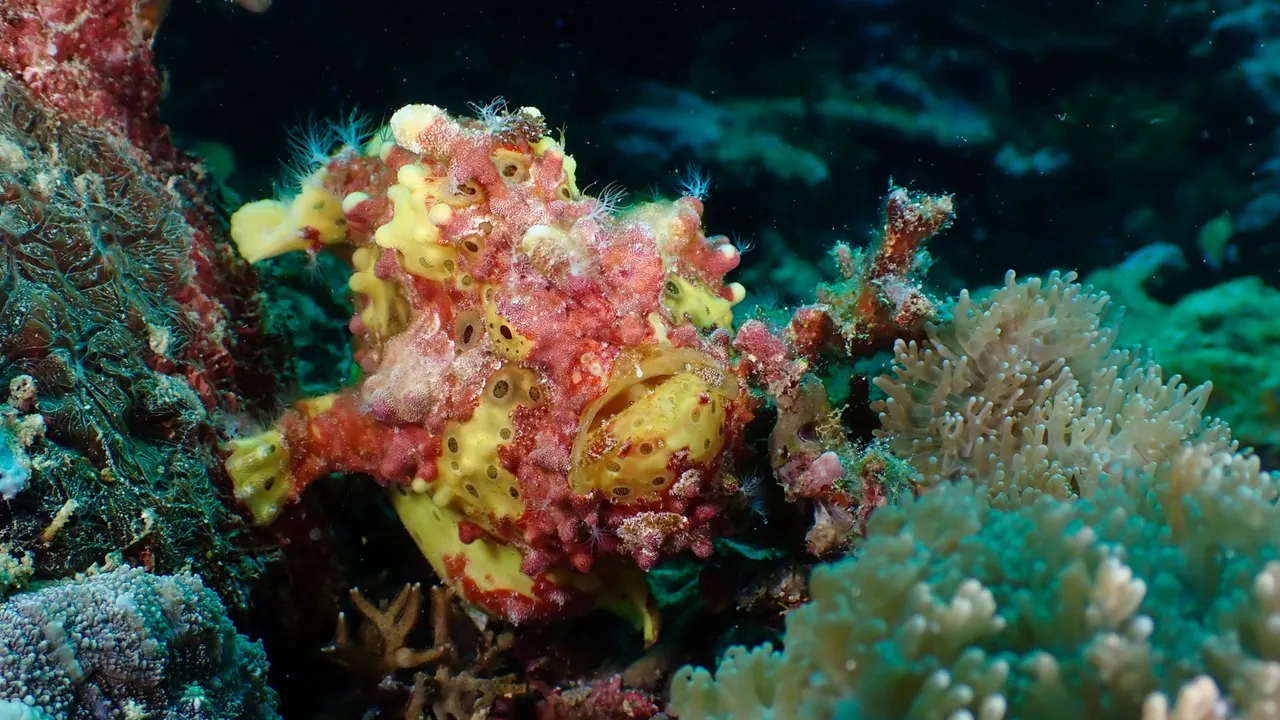
Frogfish belong to the family Antennariidae, a group of anglerfishes, and there are around fifty species. They are small — most fit in a hand — with rounded, almost spherical bodies, upturned mouths, and skin that ranges from smooth to shaggy. Rather than swimming after food, a frogfish is a sit-and-wait predator: it plants itself in one spot, disappears into the background, and lets dinner come to it. Everything about its body is built around that strategy.
The lure and the strike
The frogfish’s headline trick is that it fishes. Its first dorsal spine has evolved into a slender rod, called the illicium, tipped with a fleshy lure, or esca, that can resemble a tiny worm, shrimp, or fish. The frogfish twitches this lure in front of its mouth, and when a curious fish approaches to investigate, the frogfish strikes — opening its enormous mouth and expanding its throat to suck in a rush of water and the prey with it. The strike is among the fastest movements in the animal kingdom, over in a few thousandths of a second, far quicker than the prey can react. A frogfish can also swallow prey close to its own size.
Camouflage and ‘walking’
Camouflage is the other half of the act. Frogfish match the colour and texture of whatever they sit on — sponges, coral, algae, rubble — and can slowly shift colour over days or weeks to blend into a new perch. Many are studded with skin filaments and warty growths that break up their shape until they look like anything but a fish. They barely move: instead of swimming, they use their leg-like pectoral and pelvic fins to clamber across the bottom, and some appear to gallop. When they must, they swim in clumsy bursts by jetting water from their gill openings. Mostly, though, they stay perfectly still, which is exactly why they are so hard to spot.
Where to find frogfish
Frogfish are creatures of muck and reef edges, and one place stands above the rest: the Lembeh Strait in North Sulawesi, Indonesia, the world’s muck-diving capital and the classic destination for frogfish, including the coveted hairy frogfish. Ambon in Indonesia and Anilao and Dauin in the Philippines are also excellent. Beyond those hotspots, frogfish turn up on muck and rubble bottoms across the tropics — the trick is a good muck site and a sharp-eyed guide, since even experienced divers swim straight past them. The Southeast Asia diving calendar covers when to visit the region’s macro sites.
Photographing frogfish
Frogfish are a macro photographer’s favourite because they hold still, which is a rare gift underwater. The challenges are focus and light: they are often tucked into cluttered backgrounds, so isolating the animal — a clean angle, a snoot or careful lighting to darken the surroundings — makes the shot. Because they do not flee, there is time to work the composition, but that is no excuse to move or prod them. As with any underwater image, water shifts color even at close range, so shots benefit from correcting afterward — see why underwater photos look blue and the best underwater photo editor options, with the camera guides covering macro gear and the before-and-after gallery showing results.
A note on care
Frogfish are harmless to divers — not venomous, and their strike is only ever aimed at small fish — but they are easily stressed and easily overlooked, so the responsibility runs the other way. Never move a frogfish, lift it, or push it into the open for a better angle; shoot it where it sits, and let it keep the camouflage it worked so hard for.
Plan a trip
To dive with frogfish, base yourself in the Lembeh Strait and use the Southeast Asia diving calendar to plan. For more on the creatures you will meet, browse the other marine life guides and the rest of OceanDimana.
Field notes
Frequently asked questions
What is a frogfish?
How do frogfish catch their prey?
Why are frogfish so hard to see?
Can frogfish walk?
Where is the best place to see frogfish?
What is a hairy frogfish?
Are frogfish dangerous to divers?
Keep exploring
Continue exploring
Diving the Lembeh Strait
The world's muck-diving capital and the best place on Earth to find frogfish.
Read moreNudibranchs
The other stars of the muck — colourful sea slugs and how to find them.
Read moreBest Underwater Photo Editor
Compare Lightroom, Photoshop, Capture One, and AI editors for underwater work.
Read moreWhy Underwater Photos Look Blue
The science behind the blue-green cast, and why water steals warm color.
Read more